
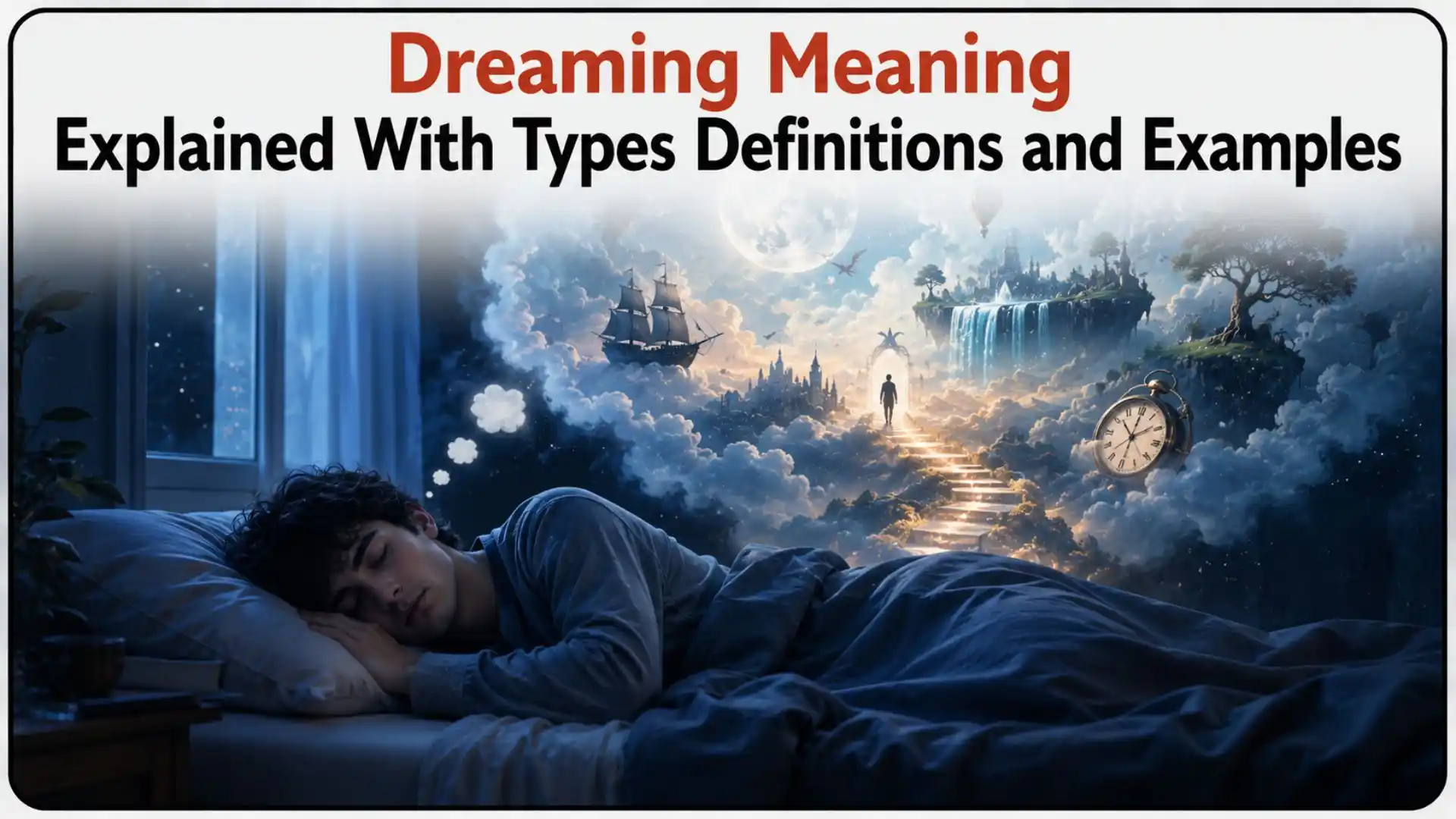
Dreaming meaning can change depending on how you use the word. In its most common sense, dreaming describes the images, thoughts, and emotions that appear during sleep. It can also mean daydreaming while awake, using your imagination, or thinking about a future goal. That is why people often search for the meaning of dreaming, the dream definition, or simply ask, what does dreaming mean?
Dreaming can connect with REM sleep, memory, emotions, imagination, hopes, and personal ambition. Some dreams feel vivid and real, while others disappear soon after waking. In this guide, you will learn the dreaming definition in simple words, the main types of dreams, the difference between dreaming and daydreaming, and how the word works as both a noun and a verb. You will also discover why people dream, why dreams feel real, and whether every dream carries a hidden meaning.
Quick Answer 💡
Dreaming means seeing images, people, places, or events in your mind while you sleep. The word can also describe daydreaming, imagination, or thinking about a future goal. In psychology, dreams may connect with memories, feelings, stress, and daily experiences. However, not every dream has a hidden message. Sometimes, the sleeping brain simply joins different thoughts and memories together. The exact dreaming meaning depends on the sentence, situation, and personal experience of the dreamer.
TL;DR
- Dreaming during sleep involves thoughts, images, and emotions.
- A daydream happens while you are awake.
- A dream can also mean a hope, goal, or ambition.
- Vivid dreams often happen during REM sleep.
- Stress, memories, and emotions may shape dream content.
- Not every dream carries a symbolic or spiritual message.
- Both dreamed and dreamt are correct.
- Keeping a dream journal may improve dream recall.

You Might Also Like That: Your Dreams Meaning
What Does Dreaming Mean?
The basic meaning of dreaming is experiencing mental images, ideas, feelings, or stories while sleeping. A person may dream about familiar people, strange places, old memories, or events that could never happen in real life. The word also has a wider meaning. Someone may say they are dreaming about a better future, a dream career, or a peaceful life. In that case, dreaming means hoping, imagining, or planning for something meaningful rather than having a sleep experience.
Dreaming Meaning in Simple Words
In simple words, dreaming means seeing or imagining something in your mind. It often happens while you sleep, but it can also happen while you are awake. For example, you may dream about flying at night, daydream about a holiday during work, or dream of becoming a doctor. These examples show three common meanings: a sleep dream, a waking fantasy, and a future ambition. The surrounding sentence usually makes the correct meaning clear.
Main Meanings of Dreaming
Dreaming During Sleep
Dreaming during sleep happens when the brain creates images, thoughts, sounds, and emotions. Some dreams feel clear and realistic, while others feel strange or confusing. You may remember a whole dream after waking, only a small part, or nothing at all. Dreams may include recent events, old memories, personal fears, hopes, or random details. Scientists continue to study why humans dream, but most agree that dreaming forms a normal part of healthy sleep.
Dreaming While Awake
Dreaming while awake usually means daydreaming. Your attention moves away from the present moment, and your mind imagines another place, event, or situation. You may daydream about travelling, meeting someone, winning an award, or changing your life. Daydreaming can support creativity and planning, but too much of it may distract you from important tasks. Unlike a sleep dream, you usually remain partly aware of your surroundings and can stop the fantasy when needed.
Dreaming About a Future Goal
Dreaming can also describe a strong hope or personal ambition. A person may dream of owning a home, starting a business, finding love, or building a successful career. In this sense, a dream gives direction and motivation. However, a dream becomes more practical when you turn it into a goal with clear steps. The phrase follow your dreams encourages people to work toward a meaningful future instead of only imagining it.
Dream as a Noun and a Verb
The word dream works as both a noun and a verb. As a noun, it names an experience, hope, or ideal situation. For example, “I had a strange dream” or “Teaching is my dream career.” As a verb, it describes the action of seeing images during sleep or imagining something: “I dreamed about the ocean.” The word dreaming often acts as the present participle, as in “She is dreaming,” but it can also function as a noun.
Dreaming Definition With Examples
The following table shows how the dream definition changes by context:
| Type | Simple meaning | Example |
| Sleep dream | Images during sleep | “I was dreaming about rain.” |
| Daydream | Imagination while awake | “He was dreaming during class.” |
| Life dream | A hope or ambition | “Her dream is to become a writer.” |
| Ideal description | Something excellent | “That house is a dream.” |
These examples help explain what dreaming means in English without using difficult vocabulary.
What Happens When You Dream? 🧠
When you dream, your brain remains active even though your body rests. It may combine memories, emotions, worries, sounds, and imagination into a story. The story may feel logical at the time, even when the events make little sense. Brain areas linked with emotion can become highly active, while areas connected with careful reasoning may work differently. This may explain why dreams often feel emotional, unusual, or impossible. Your body also changes across different stages of sleep.
Does Dreaming Only Happen During REM Sleep?
Many vivid and detailed dreams happen during REM sleep, which means rapid eye movement sleep. During this stage, brain activity rises, the eyes move quickly, and the body limits most large muscle movement. However, people can also dream during non-REM sleep. These dreams may feel less visual or dramatic, but they still contain thoughts and experiences. Therefore, dreaming does not happen only during REM sleep, although REM dreams often feel more colourful, emotional, and memorable.
Why Do People Dream?
Researchers have suggested several reasons for dreaming. Dreams may help the brain process memories, emotions, learning, fear, and daily experiences. They may also support creative thinking by joining ideas in unusual ways. Another view says dreams partly result from random brain activity that the mind tries to organize into a story. No single theory explains every dream. The safest answer is that dreaming may serve several purposes and may not work in exactly the same way for every person.
Main Types of Dreams
Ordinary Dreams
Ordinary dreams include common people, places, worries, and daily activities. They may involve work, school, family, travel, or simple conversations. These dreams often mix real memories with strange details.
Vivid Dreams
Vivid dreams feel strong, colourful, and realistic. They may remain clear after waking. Stress, changing sleep patterns, medicines, or waking during REM sleep can sometimes make them easier to remember.
Lucid Dreams
In a lucid dream, you realize that you are dreaming while the dream continues. Some people can influence part of the dream, but control varies from one dreamer to another.
Recurring Dreams
A recurring dream repeats the same event, setting, emotion, or theme. Stress and unresolved concerns may contribute, but repeated dreams do not always have one fixed meaning.
Nightmares
Nightmares are frightening dreams that may cause fear, sadness, or panic. Occasional nightmares are common, but frequent ones may disturb sleep and daily life.
You Might Also Like That: Your Dreams Meaning
Dreaming Versus Daydreaming
Dreaming and daydreaming both involve mental images, but they happen in different states. Dreaming usually occurs during sleep, while daydreaming happens when you are awake. A sleep dream may feel outside your control and contain sudden changes. A daydream often develops from your wishes, plans, or imagination. You can usually return your attention to the present when daydreaming. Both experiences may reflect emotions, memories, hopes, and creative thought.
Dreaming Versus Mind Wandering
Mind wandering happens when attention moves away from the current task. You may think about dinner, a past conversation, or tomorrow’s plans. A daydream often contains a clearer imagined scene or story, while mind wandering may include short, disconnected thoughts. Both can happen without intention. They may help with creativity or planning, but they can also reduce focus. Sleep dreaming differs because you are not fully awake or aware of your surroundings.
Dreaming Versus Imagination
Imagination is the broad ability to create ideas or pictures in the mind. Dreaming is one form of mental experience, but imagination also works during reading, writing, planning, and problem-solving. You can guide your imagination while awake, but you usually have less control over an ordinary dream. The two processes often overlap. A dream may use imaginative images, while imagination may feel dreamlike. Still, they are not always the same experience.
Psychological Meaning of Dreaming
From a psychological view, dreams may reflect thoughts, feelings, memories, stress, and personal concerns. A frightening dream may appear during a stressful period, while a peaceful dream may reflect comfort or hope. However, psychologists do not treat every dream symbol as having one universal meaning. A dog, house, road, or ocean can mean different things to different people. The best interpretation considers your emotions, current situation, and personal connection with the dream.
Spiritual Meaning of Dreaming ✨
Many spiritual traditions view dreams as sources of guidance, warning, comfort, or personal insight. Some people believe dreams connect them with intuition, faith, ancestors, or a higher power. These beliefs vary widely across cultures and religions. Spiritual dream interpretation can feel meaningful, but it remains personal and should not replace medical, legal, or practical advice. A balanced approach respects spiritual beliefs while also considering stress, memory, sleep quality, and everyday life.
Do Dreams Always Have a Meaning?
Not every dream has a clear or hidden meaning. Some dreams may reflect recent events, emotional concerns, or strong memories. Others may come from random brain activity, outside sounds, body sensations, or ordinary changes in sleep. People often remember unusual dreams and search for symbols, but one symbol does not carry the same message for everyone. When exploring the meaning of dreaming, focus on your emotions and life context rather than relying on a fixed dream dictionary alone.
Can Dreams Predict the Future?
There is no strong scientific evidence that dreams reliably predict future events. Sometimes, a dream appears to match something that happens later, but coincidence, broad details, and selective memory may explain the connection. People remember the dreams that seem accurate and often forget the many dreams that do not come true. A dream may still help you notice concerns or possibilities already present in your mind, but you should not treat it as guaranteed information about the future.
Why Do Dreams Feel So Real?
Dreams can feel real because the brain creates strong images, sounds, movement, and emotions. During some sleep stages, emotional brain areas remain active, while critical thinking works differently. As a result, you may accept impossible events without questioning them. A dream may also include familiar people and places, which makes the experience feel believable. After waking, your reasoning returns, and you may quickly notice that the story could not happen in real life.
Why Do We Forget Dreams?
People often forget dreams because the brain does not store every sleep experience as a lasting memory. You may remember more when you wake during or soon after a dream. Moving quickly, checking your phone, or thinking about the day can push dream details away. Sleep quality and attention also affect dream recall. Forgetting a dream does not mean you did not dream. Most people dream several times but remember only a small amount.
How to Remember Your Dreams 📝
To improve dream recall, keep a notebook beside your bed and write immediately after waking. Stay still for a few moments and ask yourself what you saw, felt, or heard. Record even one image or emotion because small details may bring back more memories. You can also set a calm intention before sleep, such as “I will remember my dream.” Regular sleep and fewer sudden alarms may also help. Avoid forcing an interpretation before you record the actual dream.
Dream as a Goal or Ambition
A dream as a goal describes something you strongly want to achieve. Examples include a dream job, dream home, dream holiday, or lifelong dream. This meaning focuses on hope and ambition rather than sleep. Dreams can inspire action, but clear goals require planning, time, and effort. A useful approach turns a large dream into smaller steps. In this way, dreaming supports motivation while practical action moves you closer to the desired result.
What Does Broken Dreams Mean?
Broken dreams means hopes or plans that did not happen. The phrase often expresses sadness, disappointment, lost opportunity, or failure. It does not usually describe damaged sleep dreams. For example, someone may speak about broken dreams after losing a career opportunity or ending an important relationship. Green Day’s Boulevard of Broken Dreams also uses this emotional idea, but the phrase existed before the song. Its exact meaning depends on the personal or artistic context.
Common Dream Synonyms
| Word | Meaning |
| Daydream | Pleasant thoughts while awake |
| Fantasy | An imagined situation |
| Vision | A mental picture or future idea |
| Reverie | A calm, dreamy state |
| Imagination | The ability to form ideas mentally |
| Aspiration | A strong hope or ambition |
| Nightmare | A frightening dream |
These dream synonyms overlap, but they are not always interchangeable. Choose the word that best matches sleep, imagination, fear, or ambition.
Dreamed Versus Dreamt
Both dreamed and dreamt are correct past-tense forms of dream. “Dreamed” appears more often in American English, while “dreamt” remains common in British English. You can say, “I dreamed about flying” or “I dreamt about flying.” Both sentences carry the same meaning. Use one form consistently within the same piece of writing. The present form is dream, and the continuous form is dreaming.
Common Expressions With Dream
English uses the word dream in many common expressions. A dream come true means something strongly hoped for has happened. Dream big encourages ambitious thinking. In your wildest dreams describes something extremely unlikely or surprising. Living the dream often means enjoying an ideal life, although people sometimes use it jokingly. Pipe dream describes an unrealistic hope. Learning these phrases helps readers understand the wider dream meaning in English beyond sleep.
Common Myths About Dreaming
Several dream myths can cause confusion. Everyone may dream, even if they do not remember it. Dreams do not always reveal secret wishes or predict the future. People also dream in colour, black and white, or unclear visual forms. A universal dream dictionary cannot give one correct meaning for every symbol. Finally, lucid dreaming does not always provide full control. Dream experiences differ because sleep, health, memory, culture, and personal life shape them.
When Disturbing Dreams Need Attention ⚠️
An occasional nightmare usually does not signal a serious problem. However, consider speaking with a qualified healthcare professional when nightmares happen often, cause fear of sleeping, reduce daytime energy, or follow a traumatic event. Also seek help when unusual movements, breathing problems, or severe sleep loss occur. A professional can explore sleep habits, stress, medicines, and other possible causes. Dream interpretation websites cannot diagnose physical or mental health conditions.
You Might Also Like That: Your Dreams Meaning
Frequently Asked Questions
What Is Dreaming in Simple Words?
Dreaming means seeing images, events, or ideas in your mind, usually while sleeping. It can also mean imagining something while awake or hoping to achieve a future goal.
Does Everyone Dream?
Most evidence suggests that nearly everyone dreams, although many people forget their dreams. Waking time, sleep stage, attention, and memory affect how much a person remembers.
Is Dreaming Good for the Brain?
Dreaming forms a normal part of sleep. Researchers believe it may connect with memory, emotion, learning, and creativity, although its exact purpose remains under study.
Why Do Dreams Feel Real?
Dreams feel real because the sleeping brain can create strong emotions, images, sounds, and sensations while critical thinking works differently.
What Is the Difference Between a Dream and a Goal?
A dream describes a desired future, while a goal usually includes a clear plan, deadline, and action steps. Turning a dream into goals makes it easier to achieve.
Final Thoughts
Dreaming meaning includes more than one idea. It can describe mental experiences during sleep, imagination while awake, or a meaningful future goal. Dreams may draw from memory, emotion, stress, creativity, and daily life, but they do not always carry hidden messages. The best way to understand a dream is to consider your personal feelings and situation. Whether you study dreams scientifically, psychologically, spiritually, or linguistically, a balanced view gives the clearest and most helpful answer.